Following the success of the conference held on July 31, 2026 in Dong Thap province, on August 14, 2026, in Thanh Hoa, the Ministry of Industry and Trade continued to organize a conference to disseminate the Circular guiding localities in the Northern region to implement some criteria under the National Criteria Set for New Rural Communes in the period 2026 - 2030 within the scope of state management of the Ministry of Industry and Trade.
The national criteria for new rural communes for the period 2026-2030, issued with Decision No. 51/2025/QD-TTg dated December 29, 2025, by the Prime Minister, will take effect from February 15, 2026. This serves as the basis for localities to organize the implementation, evaluation, and recognition of communes that meet the new rural commune standards during the 2026-2030 period.
.jpeg)
Overview of the Conference
To guide localities in effectively implementing several criteria under the National Criteria Set for New Rural Communes in the 2026-2030 period within its management scope, the Ministry of Industry and Trade assigned the Department of Innovation, Green Transformation and Industrial Promotion (DCK) to lead and coordinate with several units under the Ministry (Electricity Department, Domestic Market Management and Development Department, E-commerce and Digital Economy Department) to organize guidance conferences. Specifically, representatives from the Electricity Department provided guidance on: “Content of Criterion 2.4: Percentage of households directly registered and using electricity for domestic and production purposes, ensuring safety, reliability, and stability”; representatives from the Domestic Market Management and Development Department provided guidance on: “Content of Criterion 2.5: Rural commercial infrastructure” and other assigned guidance within the Program; and representatives from the E-commerce and Digital Economy Department provided guidance on: “Content of Criterion 7.3: Effective implementation of e-commerce activities”.
It's not just about measuring "whether it happens or not," but about measuring its effectiveness.
At the conference, Mr. Nguyen Huu Tuan - Director of the Center for E-commerce and Digital Technology Development (eComDX) - the unit assigned by the Department of E-commerce and Digital Economy to guide the implementation of Criterion 7.3 on e-commerce in building new rural areas in localities during the 2026-2030 period - specifically introduced Criterion 7.3, answered questions during the implementation process, and suggested many practical ways to achieve the goal of building effective e-commerce communes.
.jpeg)
Mr. Nguyen Huu Tuan - Director of eComDX - presented his paper at the Conference.
Mr. Tuan believes that e-commerce at the commune level is not limited to the buying and selling of goods but also includes online tourism services, online food businesses, technology-based transportation, delivery services, and other digital services. The participating entities are also very diverse, ranging from businesses, cooperatives, household businesses to individual entrepreneurs.
According to Mr. Tuan, "it's impossible to conclude about the effectiveness of e-commerce in a locality simply by counting the number of stalls, training sessions, or products uploaded to the digital environment." A locality may have complete reports on the number of training classes, the number of participants, and the number of products promoted; but those numbers are insufficient to fully reflect effectiveness without knowing how many entities actually apply the technology, how many orders are generated, how much online revenue is achieved, and how the market has expanded.
In implementing Criterion 7.3, the requirement is not only to identify what activities have been implemented in the locality, but more importantly, to demonstrate how e-commerce activities are creating real economic value. Combining data from business operations, digital platforms, logistics, sample surveys, and government management data is considered a crucial approach to enhance objectivity and transparency in the evaluation.
He emphasized: “The implementation of Criterion 7.3 in the new rural development program for the period 2026-2030 requires a qualitative change, from “having e-commerce activities” to “e-commerce creating value.” From there, he defined effective e-commerce implementation as the establishment of infrastructure, ecosystems, or synchronized operations where business entities proficiently utilize digital skills to directly distribute and sell products through digital platforms, thereby achieving tangible economic efficiency, optimizing logistics, and ensuring transparent product traceability.”
To achieve this, Mr. Tuan suggested that localities need to approach e-commerce from the perspective of an economic ecosystem, in which people, platforms, logistics, data, and management mechanisms all participate in a unified value chain.
In particular, combining logistics data, platform data, sample surveys, socio-economic data, and tax management data will provide a basis for localities to gradually quantify the scale of e-commerce activities, instead of just evaluating them based on evidence of "activity."
Three pillars and five steps of implementation
Criterion 7.3 is comprised of three major content groups: digital capabilities and skills, the local community ecosystem, and the level of e-commerce implementation. In his presentation at the conference, the Director of eComDX quantified these indicator groups according to specific evaluation levels.
However, from an implementation perspective, Mr. Tuan noted that the three content groups should not be viewed as separate components. The representative from the Department of E-commerce and Digital Economy argued that a locality can organize many training programs, but if businesses cannot apply the knowledge to their sales activities, the effectiveness will be limited. Conversely, if there is a supporting ecosystem but no transactions are generated, no revenue is produced, or the market is not expanded, it does not fully reflect the effectiveness of e-commerce.
According to Mr. Tuan, the new aspect in the approach to Criterion 7.3 is the requirement for data connectivity between agencies and units.
Data on e-commerce activities can be found in many places: State management agencies hold administrative data; postal units hold delivery data; technology platforms hold transaction data or the activities of service providers; tax authorities hold data on tax declarations and obligations; localities have socio-economic data; and businesses themselves have information on revenue and the proportion of online sales… “ If these data sources are exploited separately, the picture of e-commerce will lack comprehensiveness. Conversely, with a coordination mechanism, data can be used to compare, correct, and verify each other ,” Mr. Tuan affirmed.
Therefore, Mr. Tuan proposed establishing an inter-agency working group to collect foundational and administrative data, organize sample surveys, synthesize the data, and then compare it with tax management data to adjust the results. This is not only a technical process to serve the evaluation of Criterion 7.3, but can also create a foundation for the formation of a local e-commerce database.
Experts from the Department of E-commerce and Digital Economy suggest that, in order to fulfill the requirements of Criterion 7.3, communes need to implement a five-step roadmap:
Firstly, it is necessary to prepare and establish an inter-agency task force. This task force will serve as the central coordinating body among relevant agencies and units in collecting, compiling, and verifying data.
Secondly, collect foundational and administrative data. This forms the basis for determining the scale of the business entity, commercial and service activities, and potential data sources to be exploited.
Third, conduct a sample survey at the grassroots level. The survey content focuses on the level of use of online sales channels, the platforms used, and the proportion of online revenue.
Fourth, data aggregation and generalization calculations are performed. Depending on the specific group of goods, services, and location, an appropriate estimation method can be selected.
Fifth, verification, comparison, and database construction. The estimated results are compared with other management data sources to correct errors and gradually build an e-commerce database to serve policy planning.
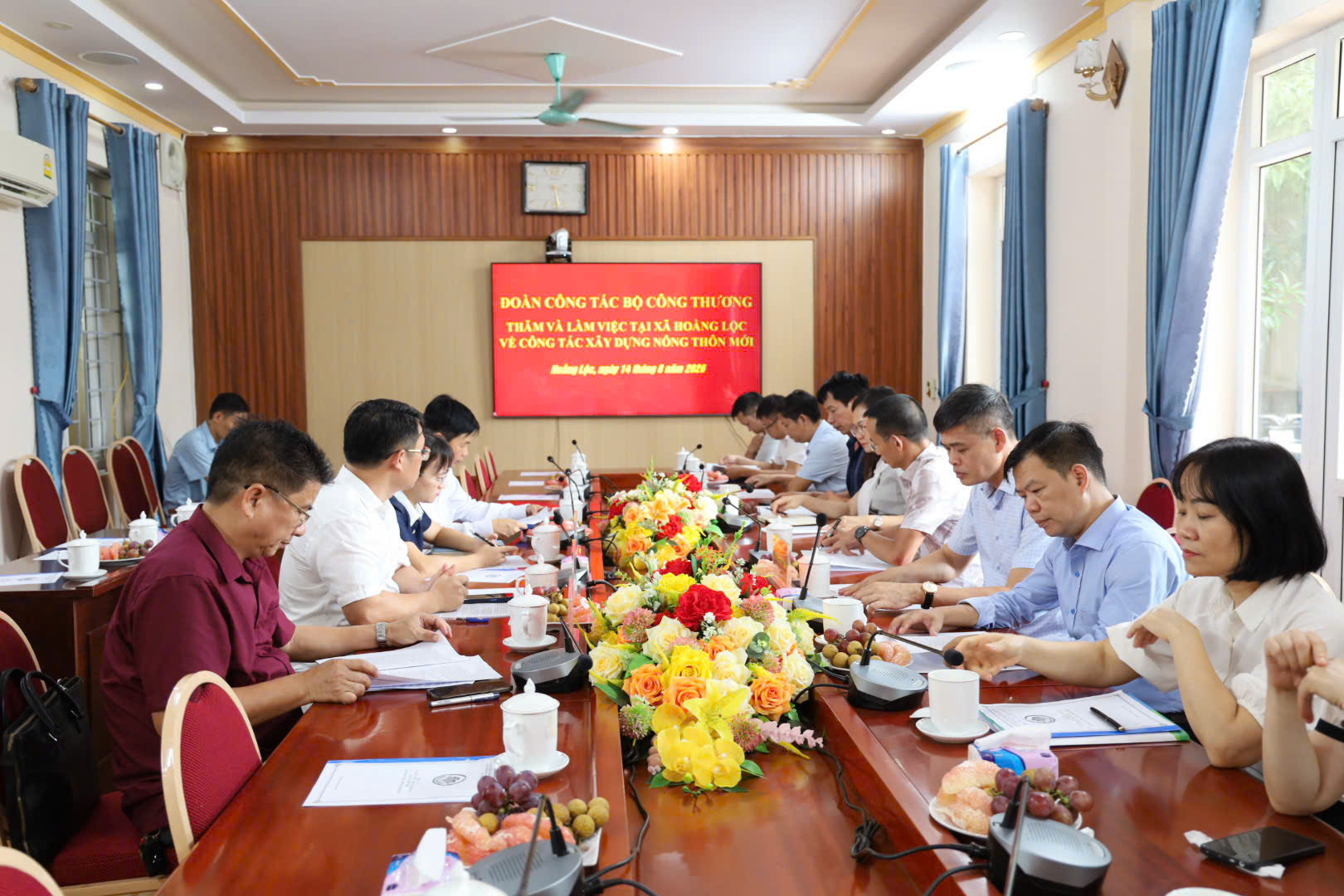
The working group from the Ministry of Industry and Trade visited several communes in Thanh Hoa province on the afternoon of August 14, 2026.
The conference, held on the morning of August 14, 2026, aimed to disseminate several new documents on the National Target Program for New Rural Development in the 2026-2035 period; and to implement Circular No. 17/2026/TT-BCT of the Ministry of Industry and Trade guiding the implementation of some criteria under the National Criteria Set for New Rural Communes in the 2026-2030 period. In the afternoon of the same day, delegates participated in a field survey in several communes in Thanh Hoa province to support the implementation of criteria related to the Industry and Trade sector in new rural development.
eComDX partners with local authorities to promote e-commerce and build new rural areas. As the unit assigned by the Department of E-commerce and Digital Economy to guide and advise on the implementation of Criterion 7.3 on E-commerce in the National Target Program for Building New Rural Areas giai đoạn 2026-2030, the Center for E-commerce and Digital Technology Development (eComDX) is actively accompanying localities nationwide in the implementation process. With a focus on tangible results, eComDX will continue to work alongside localities to effectively implement Criterion 7.3, contributing to expanding markets for rural products, increasing people's income, promoting the development of the digital economy, and successfully implementing the National Target Program for New Rural Development in the 2026-2030 period. |
Related articles: